

Deep Dive Analysis: General Dynamics Corporation (GD)
The Aerospace Peak, The ESG Pivot, and The Valuation Ceiling

Quick View
Ticker: GD
Sector: Defence
Theme: Potential entry fo “ESG-restricted” capital.
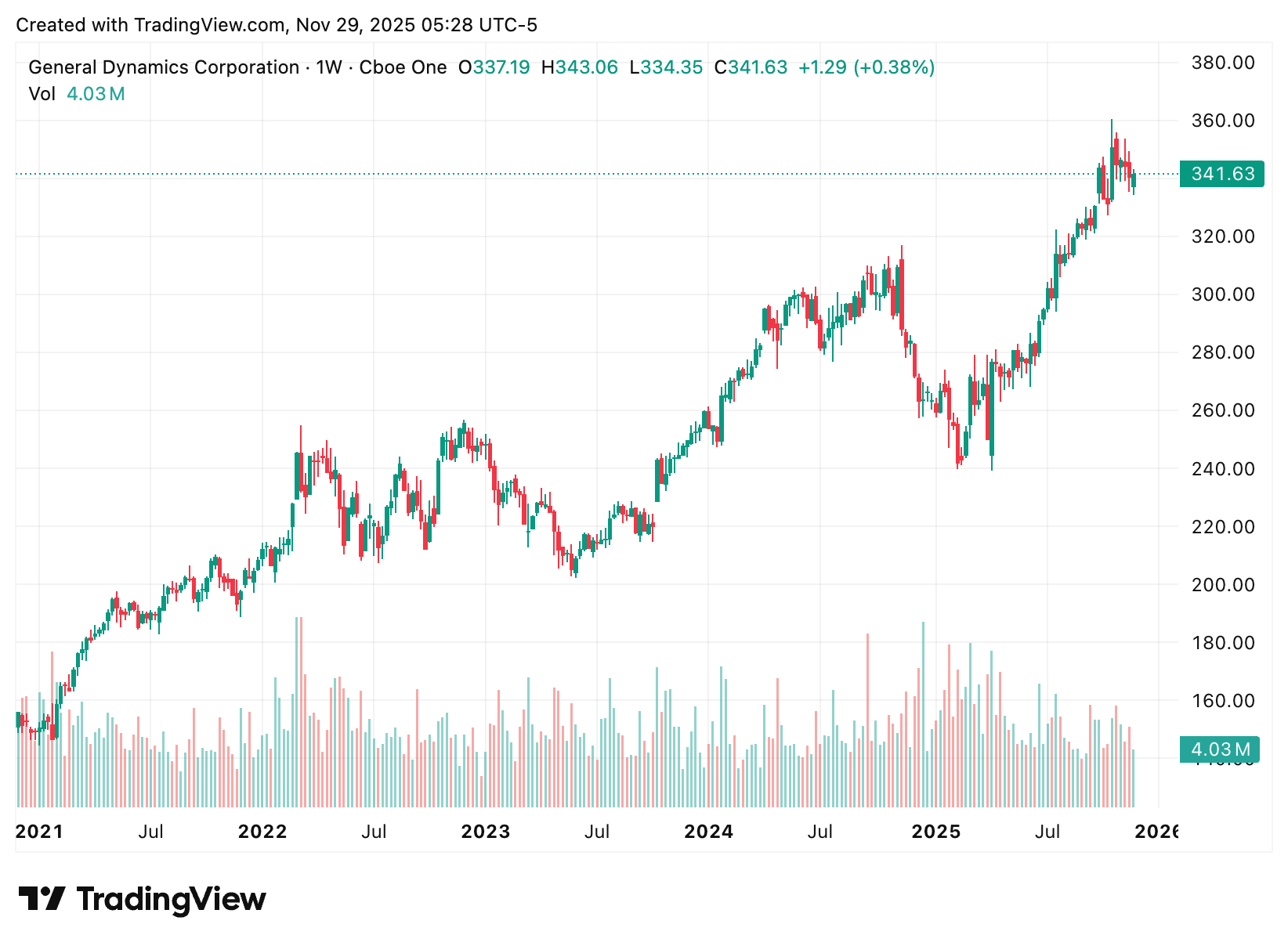
TBFG angle: General Dynamics is currently firing on all cylinders with the G700 cycle fully active and defense backlogs at record highs.
12-month scenario range (USD):
Bear: $260-280
Base: $350-365
Bull: $390-410
TBFG Bottom Line
The investment case for GD has strengthened fundamentally throughout 2025. The company is accelerating, evidenced by a massive jump in Free Cash Flow ($3.0B YTD 2025 vs $1.39B YTD 2024) and a record backlog of $109.9B. The “Aerospace Super-Cycle” is real, with G700 deliveries driving a 30% revenue jump in that segment in Q3.
Why it’s not a “Strong Buy”: Valuation. The market has efficiently priced in both the G700 success and the geopolitical tailwinds. Trading at ~22x trailing Owner Earnings, GD is historically expensive. We are observing a classic “great company, fair (to expensive) price” scenario.
The “Friday Signal” changes the risk profile (lowering downside risk due to new structural buyers), but it doesn’t necessarily justify chasing the stock at all-time highs without fundamental valuation support.
Business Snapshot
GD is a dual-threat industrial giant: premier business aviation (Gulfstream) and mission-critical defense platforms (Submarines, Tanks, IT).
2025 YTD Performance (9 Months):
Aerospace (~24% of Rev): The star performer. Revenue up 24.2% and Margins expanded to 13.6%. Driven by G700 deliveries and stabilizing supply chains.
Marine Systems (~31% of Rev): The steady compounder. Revenue up 14.7%. Continued ramp on Columbia and Virginia-class submarines.
Combat Systems (~18% of Rev): Stable. Revenue up 1.7%. Driven by munitions demand (Ukraine/Israel context).
Technologies (~27% of Rev): Revenue up 3.5%. IT services seeing higher volume.
TBFG-Category: Stalwart (Trending Fast-Grower) Usually a slow-growing Stalwart, GD is currently exhibiting “Fast Grower” characteristics (YTD EPS growth ~19%) due to the cyclical peak in Aerospace deliveries.
Management & Governance
Leadership: Phebe N. Novakovic (CEO since 2013) is the defining force behind GD. She is a former intelligence officer and DoD official, known for a “no-nonsense,” operationally focused leadership style. She prioritizes cash flow and ROIC over vanity metrics.
Capital Allocation Discipline:
Dividends: 28 consecutive years of increases. Paid $1.2B in dividends YTD 2025.
Buybacks: Repurchased 2.4 million shares for $600M in the first 9 months of 2025. This is an acceleration compared to 2024 ($183M), indicating management sees value even at these levels, though they remain disciplined.
Debt: The company maintains a strong balance sheet, repaying $1.5B in fixed-rate notes YTD 2025.
Governance Signal: Management successfully navigated the G700 certification delays (which plagued 2023/2024) and is now delivering on the promised cash flow ramp. This execution credibility commands a premium.
Market & Competitive Landscape
Moat: Wide & Widening (Intangible & Switching Costs)
Switching Costs (Defense): 70% of revenue comes from the U.S. Gov. GD is the prime contractor for nuclear submarines (Marine Systems) and the Abrams tank. The $109.9B backlog locks customers into decades-long cycles. You cannot simply “switch” submarine providers; the barrier to entry is effectively infinite.
Intangible Assets (Aerospace): Gulfstream holds the premier brand position in ultra-long-range business jets. The new G700/G800 cycle reinforces this technological lead against Bombardier and Dassault.
Structural Moat Reinforcement (The “Friday Signal”): The potential lifting of the ban on defense stocks by Norway’s $1.7T sovereign fund changes the landscape. It signals the end of the “ESG Discount.” This legitimizes the sector for broader institutional capital, deepening the “financial moat” by ensuring access to capital and structurally supporting higher valuation multiples.
Financial Trajectory
The financial picture has shifted from “recovery” to “acceleration” in 2025.
Revenue Growth: Q3 Revenue $12.9B, up 10.6% YoY.
Margin Expansion: Operating margin expanded to 10.3% in Q3 (up 20bps), driven by Aerospace margins hitting 13.3%.
Cash Flow Inflection: This is the most critical metric
OCF (9M 2025): $3.56 Billion (vs $1.95B in 2024).
Free Cash Flow (9M 2025): $3.0 Billion (vs $1.39B in 2024).
Conversion: FCF was 98% of Net Earnings. This indicates exceptionally high earnings quality.
Growth Drivers & Strategic Optionality
The G700/G800 Cycle: We are in the early innings of the G700 delivery ramp. This aircraft has higher margins and a massive waiting list. The G800 follows, providing visibility through 2027.
The Submarine Super-Cycle: The Columbia-class ballistic missile submarine is a top strategic priority for the US Navy. This provides a “floor” for revenue growth in Marine Systems for the next 15 years.
Munitions Demand: The war in Ukraine and conflict in the Middle East have depleted NATO stockpiles. Combat Systems (producing 155mm artillery and tank ammo) is seeing a sustained demand signal that will last for years to replenish stocks.
Financial Quality, Cyclicality, and Execution Risk
Owner Earnings (Estimate): Based on 9M 2025 results, annualized Owner Earnings (FCF) track toward ~$4.0 Billion. The reported Net Income matches FCF closely, confirming clean accounting.
Cyclicality:
Aerospace: Highly cyclical. Leveraged to corporate profits and wealth creation. A recession poses a risk here.
Defense: Counter-cyclical economically, but politically cyclical.
Execution Risk (Inversion)
Government Shutdown (Immediate): The Q3 10-Q explicitly warns of a shutdown risk due to Congress not passing funding bills. This would delay contract awards and cash collections.
Aerospace Regulation: Any safety failure or certification delay on the upcoming G800 would crush the high-margin growth thesis.
Valuation
We use Owner Earnings and PEGY to triangulate value, ignoring cosmetic accounting.
Owner Earnings (TTM): ~$4,233 Million.
Forward P/E: ~20x.
PEGY Ratio: With a forward growth estimate of 10%. Conservative long-term blend of Defense stability + Aerospace cycle.
Rule of Thumb: < 1.0 is Cheap; 1.0-1.2 is Fair; > 1.5 is Expensive.
PEGY 10% = 1.7 → Expensive.
Reverse DCF Requirement: To justify the current price with PEGY ~1, General Dynamics must grow earnings ~18% annually for multiple years. Unrealistic for a “stalwart” company and far above the 10 year average growt.
Peer Comparison (Trailing and Forward P/E): RTX Corp (35 / 26), Lockheed Martin (25 / 25) and Northrop Grumman (20 / 20).
General Dynamics is fairly valued relative to its closest peer, Northrop Grumman (both ~20x Forward P/E). It trades at a discount to the commercial-heavy RTX but at a significant premium to the sector heavyweight, Lockheed Martin. The “Hold” rating is supported by this relative comparison: you are paying a full price for GD’s quality, while cheaper alternatives (like LMT) exist for pure defense exposure.
Valuation Summary:
A PEGY of 1.70 is expensive (Target < 1.0). Even if we assume a bullish 15% growth rate due to the G700 ramp, the PEGY is ~1.2.
The market is pricing GD as if the current Aerospace growth spurt is permanent, rather than cyclical. While the “Norway Signal” justifies a higher floor for the P/E (preventing a collapse to 15x), it does not justify expanding the multiple further from 20x.
Scenario Map (12-Month Outlook)
---------------------------------------------------------------
Bull Case    : “Norway Signal” triggers institutional buying.
                P/E expands to 24x.                        →   $390-410
Base Case    : Earnings grow ~10-12% as expected. Valuation holds steady (P/E ~20x)     due to strong defense floor.                →   $350-365

Bear Case    : Recession hits private jet orders.
               P/E reverts to 10-year mean (16x-17x).      →   $260-280
---------------------------------------------------------------
TBFG Positioning View
Rating: HOLD
General Dynamics is a “Sleep Well at Night” stock that has become expensive. The business is performing brilliantly, and the geopolitical environment is the best it has been for defense contractors in decades.
Actionable Advice:
Holders: Do not sell. The combination of the Aerospace up-cycle and the “Norway Signal” (structural capital inflows) creates a powerful tailwind. The dividend is safe and growing.
New Buyers: Wait. A PEGY of 1.70 offers no margin of safety. Watch for the “Government Shutdown” headline risk mentioned in the Q3 report. If that noise drops the stock toward $300 (P/E ~17-18x), that is your entry point.