

One Dollar, Three Income Statements
A field guide to the circular machine, what would break first, and why "fraud" is the wrong word for something this well documented.

The AI boom's biggest numbers — $725 billion of capex, trillion-dollar order books, the largest funding round in history — are real, disclosed, and quietly counting the same money more than once. A field guide to the circular machine, what would break first, and why "fraud" is the wrong word for something this well documented.
Follow one dollar.
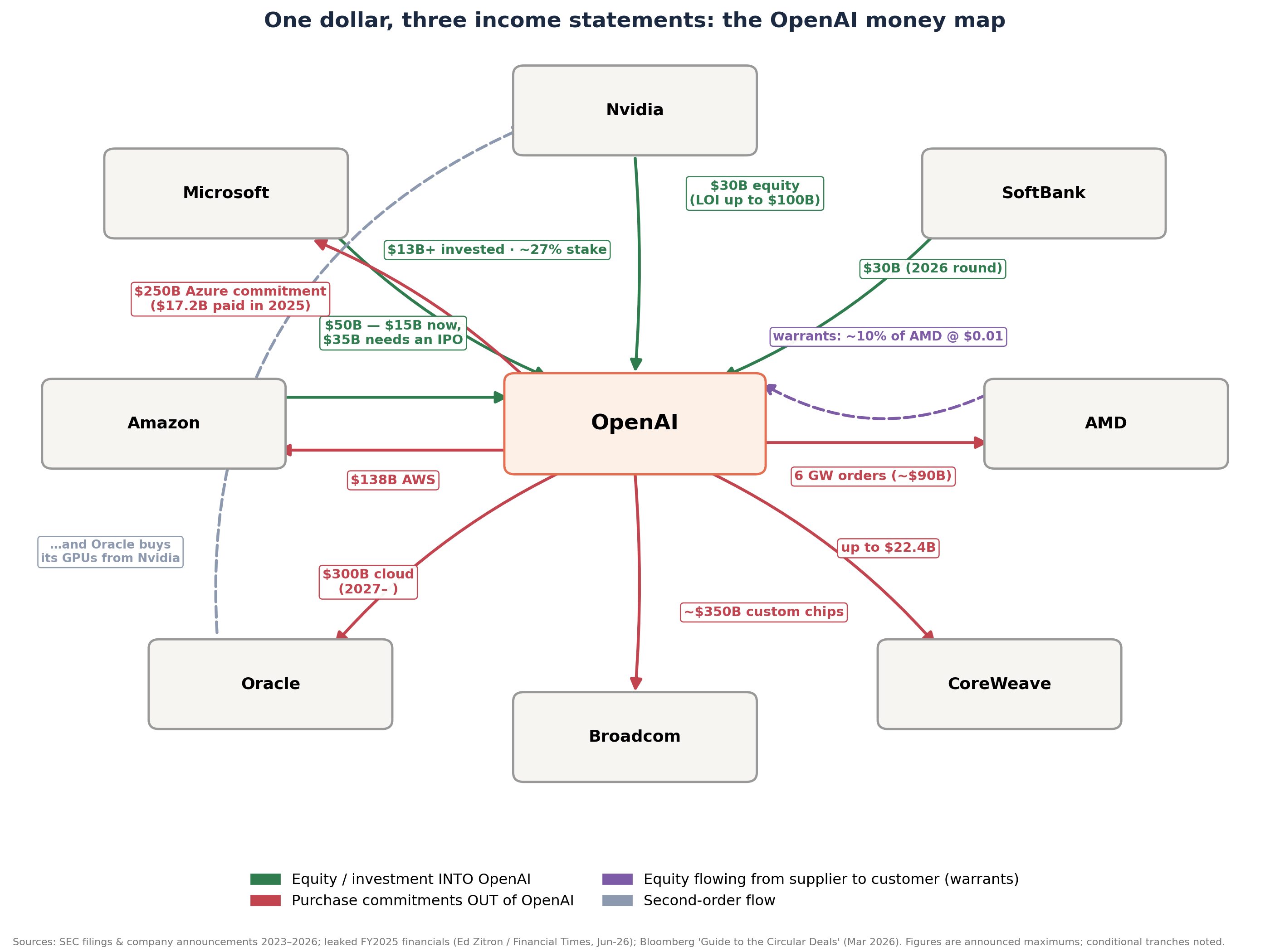
In late February, Nvidia wired $30 billion to OpenAI as its share of the largest private funding round ever assembled. OpenAI, in turn, owes Oracle more than $300 billion for cloud capacity starting next year — the largest cloud contract ever signed. And Oracle, to build that capacity, is spending tens of billions of dollars on, if you check the invoice, Nvidia GPUs.
Follow the dollar around the loop and something odd happens: it comes home. It left Santa Clara as an investment and returned as revenue. Along the way, it also managed to be OpenAI’s funding round and Oracle’s backlog. One dollar; three income statements; three charts going up and to the right.
Here is the part that makes this a story worth three thousand words rather than a tweet: nobody lied. Every leg of that journey sits in an SEC filing, a press release, or an earnings call. The auditors signed off. The lawyers signed off. Each company’s numbers are, individually, correct.
The question this piece tries to answer is what happens when you stop reading the numbers individually.
The scoreboard
First, the scale, because the scale is the point.
At April’s first-quarter earnings, the four big hyperscalers set their 2026 capital-expenditure plans: roughly $200 billion at Amazon, $190 billion at Microsoft, $180–190 billion at Alphabet, and $125–145 billion at Meta. Call it $700–725 billion combined — up roughly 72% from the $413 billion they actually spent in 2025 ($131.8B, ~$118B, $91.4B and $72.2B respectively), which was itself a record. Goldman Sachs now models something like $5.3 trillion of combined spending from these four companies through 2030.
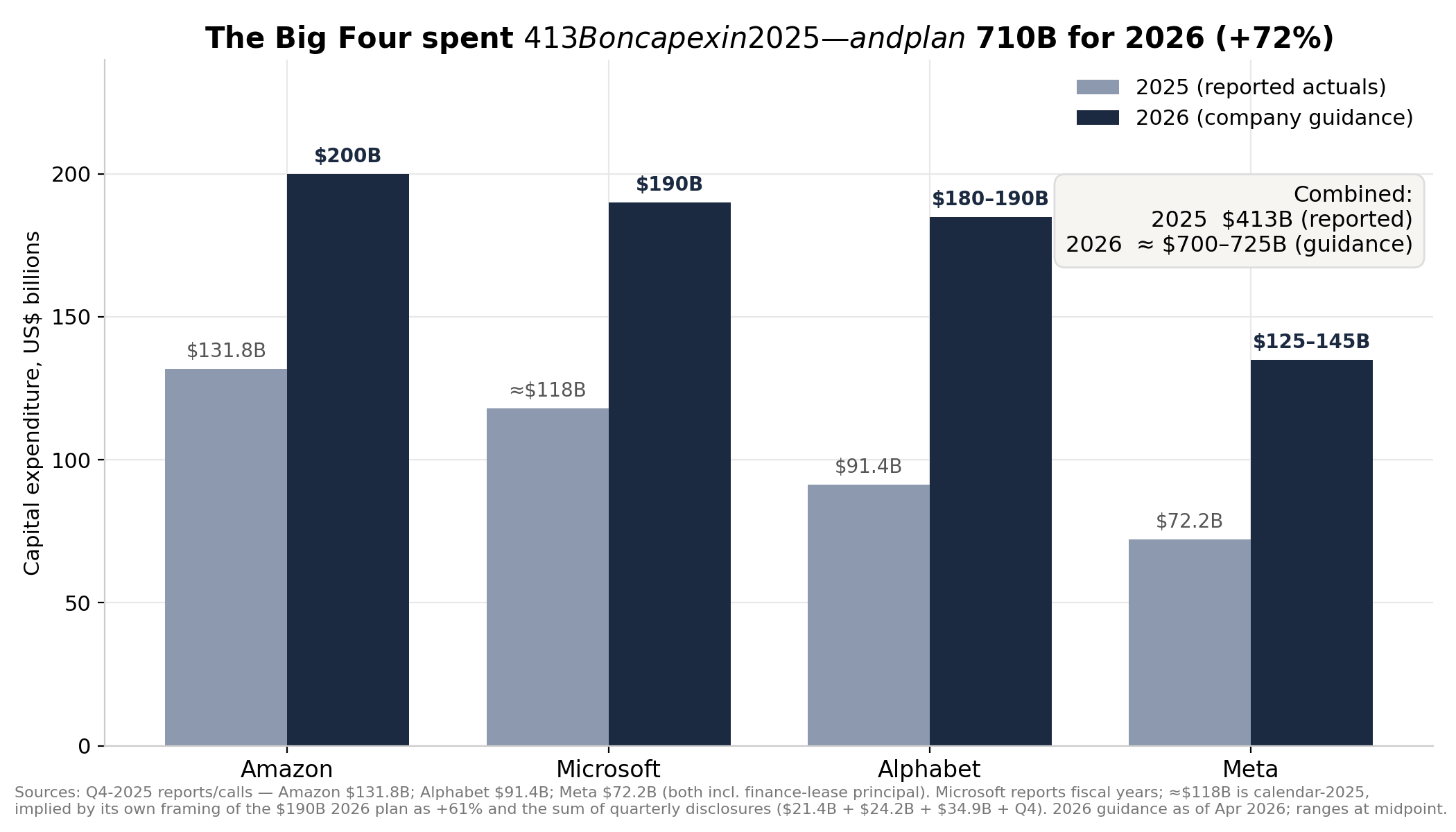
For context, $725 billion in one year is more than the inflation-adjusted cost of the entire Apollo program, spent annually, by four companies, mostly on chips with a two-to-three-year product cycle. It is being financed less and less from operating cash flow: Amazon’s free cash flow is projected to go negative this year, Alphabet launched a $40 billion at-the-market equity program plus a $10 billion private placement to Berkshire Hathaway earmarked for AI infrastructure, Oracle is raising ~$40 billion in debt and equity, and Meta financed its Louisiana campus through a reported ~$27–30 billion special-purpose vehicle with Blue Owl. Even Warren Buffett’s cash pile is now plumbed into the machine.
Spending on this scale needs demand on this scale. The industry’s answer is a set of numbers even bigger than the capex: order books. Oracle’s contracted backlog hit $638 billion. Google Cloud’s reached $462 billion. Microsoft says it has ~$80 billion of Azure demand it physically cannot serve because it lacks the power.
The bull case is that these backlogs prove the demand is real. The interesting question is where the backlogs came from. So let’s open the machine.
Loop one: the OpenAI grand tour
OpenAI closed its record round on February 27 — $110 billion at the time, $122 billion by the final close in March, at an $852 billion post-money valuation. The anchor contributors: Amazon at $50 billion, Nvidia at $30 billion, SoftBank at $30 billion.
Read that list again. $80 billion of it came from two of OpenAI’s own suppliers. Amazon’s check arrived in the same announcement as OpenAI expanding its AWS purchase commitment by $100 billion over eight years (on top of $38 billion committed in November) and adopting Amazon’s Trainium chips at gigawatt scale. Nvidia’s check is the surviving piece of a September 2025 letter of intent to invest up to $100 billion as OpenAI deploys 10 gigawatts of Nvidia systems — an investment literally metered in chip purchases.
Stack up everything OpenAI has promised to spend and you get roughly $1.25 trillion across seven vendors: ~$350 billion to Broadcom for custom chips, $300 billion-plus to Oracle, $250 billion to Microsoft’s Azure, $138 billion to AWS, the 10-gigawatt Nvidia program, ~$90 billion to AMD, $22.4 billion to CoreWeave. Against that: $13.07 billion of 2025 revenue — and a $20.9 billion operating loss earning it, per audited financials that leaked in June and were verified by the Financial Times. (You may see a $38.5 billion “net loss” headline; $41.6 billion of that is a non-cash fair-value charge from the for-profit conversion, so the operating line is the honest number.) Leaked first-quarter 2026 figures annualize to roughly a $28 billion operating loss — a better margin than last year, but more dollars, and the dollars grow with the revenue.
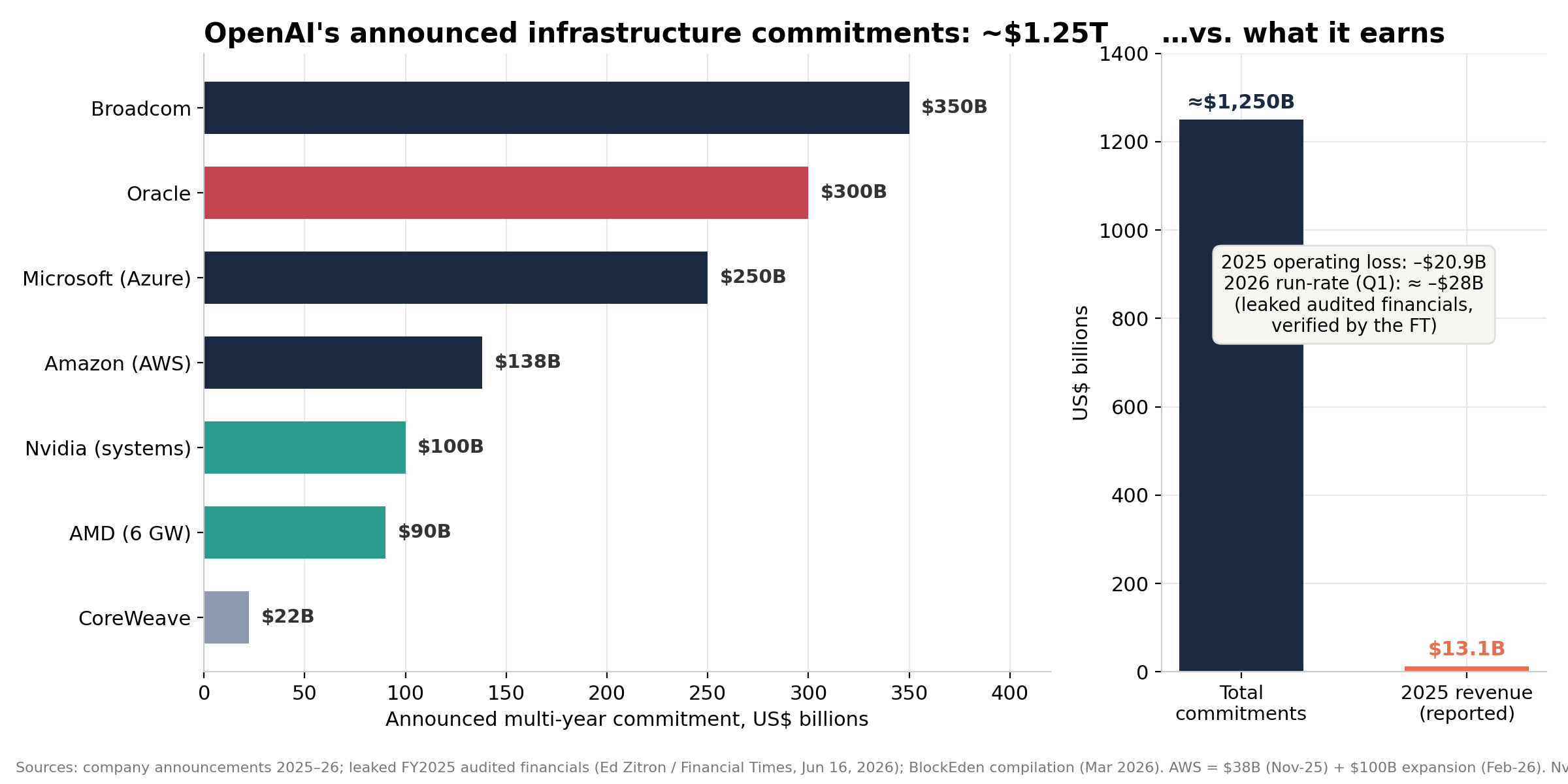
A commitments-to-revenue ratio in the neighborhood of 100:1 would normally be a solvency question. Here it is a plumbing question, because the entities owed the money keep supplying it. Microsoft put in $13 billion-plus over the years and holds roughly 27% of the company; its reward includes a $250 billion Azure commitment — and, less advertised, a slice of OpenAI's losses landing on Microsoft's own income statement each quarter under equity accounting. The leaked financials put a number on the round trip: of OpenAI's $34 billion in total 2025 costs, $17.2 billion was paid to Microsoft — the company's largest investor is also its largest vendor and its single biggest expense line. Every major vendor on that list is also an investor, a warrant-holder, or both.
Loop two: the Anthropic triangles
If OpenAI’s web is a tangle, Anthropic’s is geometry — the same triangle, drawn four times, which makes it the cleanest specimen in the jar.
November 2025: Microsoft commits up to $5 billion and Nvidia up to $10 billion; announced in the same breath, Anthropic commits $30 billion to Azure — which runs on Nvidia hardware. Fifteen billion in, thirty billion back out through the investors’ tills.
April 20, 2026: Amazon adds $5 billion (taking its total to $13 billion, with up to $20 billion more on commercial milestones); announced in the same breath, Anthropic commits more than $100 billion to AWS over ten years, on up to five gigawatts of Amazon’s own Trainium silicon.
April 24, 2026 — four days later: Google commits $10 billion at a $350 billion valuation, with $30 billion more contingent on performance targets; announced in the same breath, Google Cloud agrees to supply Anthropic five gigawatts over five years. A detail for connoisseurs: investors were reportedly offering Anthropic capital at valuations above $800 billion at the time. Google paid $350 billion. The discount, one infrastructure analyst noted, is best understood as compensation for the compute lock-in — meaning part of the “investment” is economically a customer-acquisition cost for Google Cloud.
And then the control group. In May, Anthropic agreed to pay SpaceX $1.25 billion a month through May 2029 for the Colossus clusters (~325,000 Nvidia GPUs) — with zero SpaceX equity flowing the other way, and a mutual 90-day exit after an initial period. That’s what a pure customer relationship looks like. It is the only triangle with a missing side.
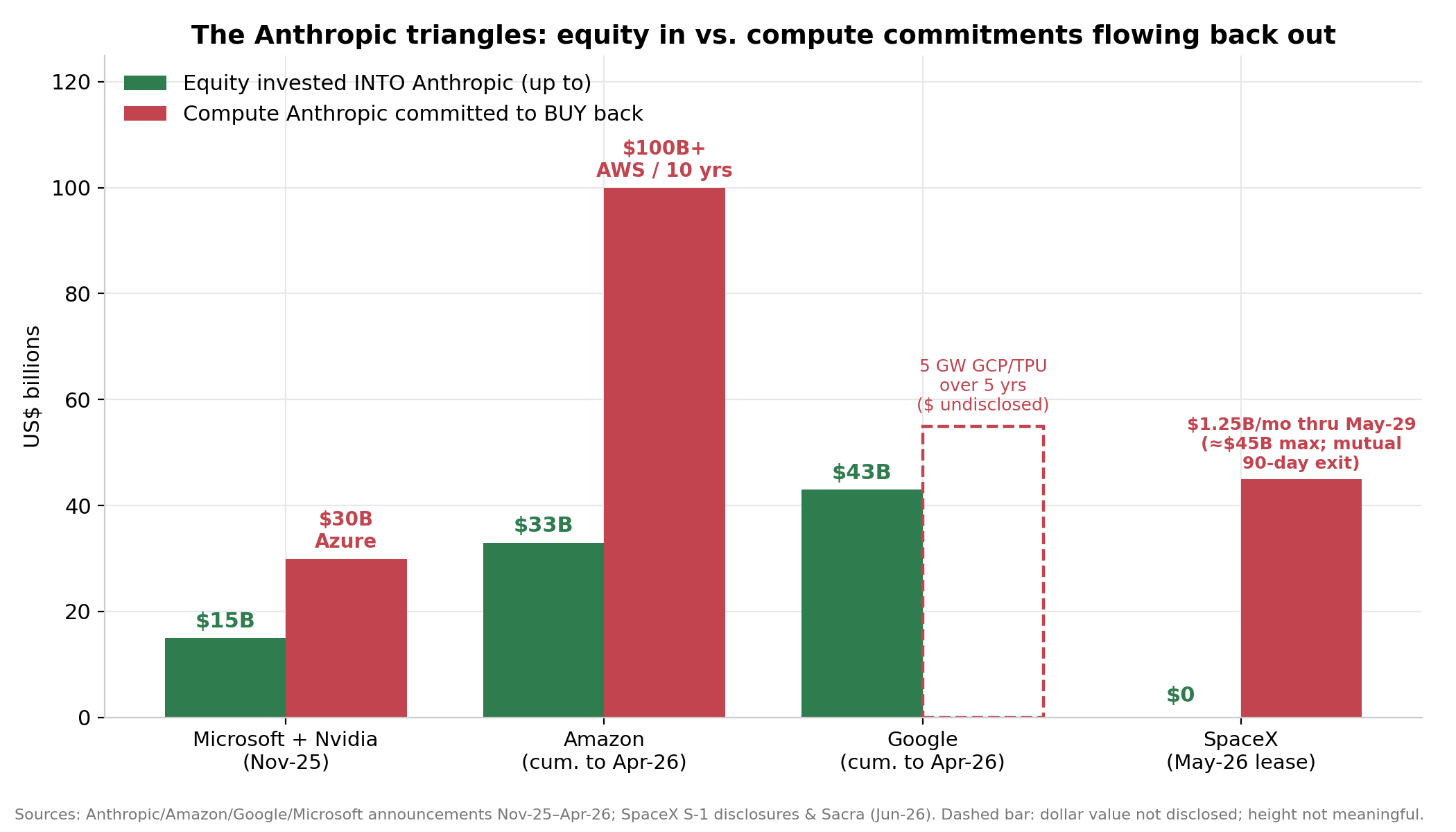
To be fair to Anthropic, its investors are rivals of one another — Amazon, Google, Microsoft and Nvidia all hold stakes, which cuts against any captive-lab narrative, and its revenue run-rate hit $47 billion by mid-May — up from roughly $9 billion at the end of 2025 and $1 billion in late 2024 — disclosed alongside a $65 billion Series H at a $965 billion valuation and a confidential S-1 filed June 1. The demand appears very real. But the geometry stands: every equity check into the company pairs with a larger purchase commitment flowing back out to the writer of the check, and each hyperscaler then reports that commitment inside the order books we met a few paragraphs ago.
Loop three: the inverted loop, in which AMD pays its customers
AMD looked at all this and ran the circuit backwards.
In October 2025 it won OpenAI as an anchor customer for up to six gigawatts of GPUs. The sweetener: a warrant for 160 million AMD shares — about 10% of the company — at one cent per share, vesting as OpenAI deploys. In February 2026 it signed Meta on structurally identical terms: up to six gigawatts, reported at over $100 billion, another 160-million-share warrant at a penny.
Add it up and AMD has pledged roughly 20% of itself to its two biggest customers as an inducement to buy its chips. One analyst’s dry verdict at the time: needing to hand over a tenth of the company suggests the organic demand needed help. Under GAAP, customer warrants are eventually netted against the revenue they generate — but headlines and price targets are set on the gross “$100 billion deal” long before that accounting drag lands.
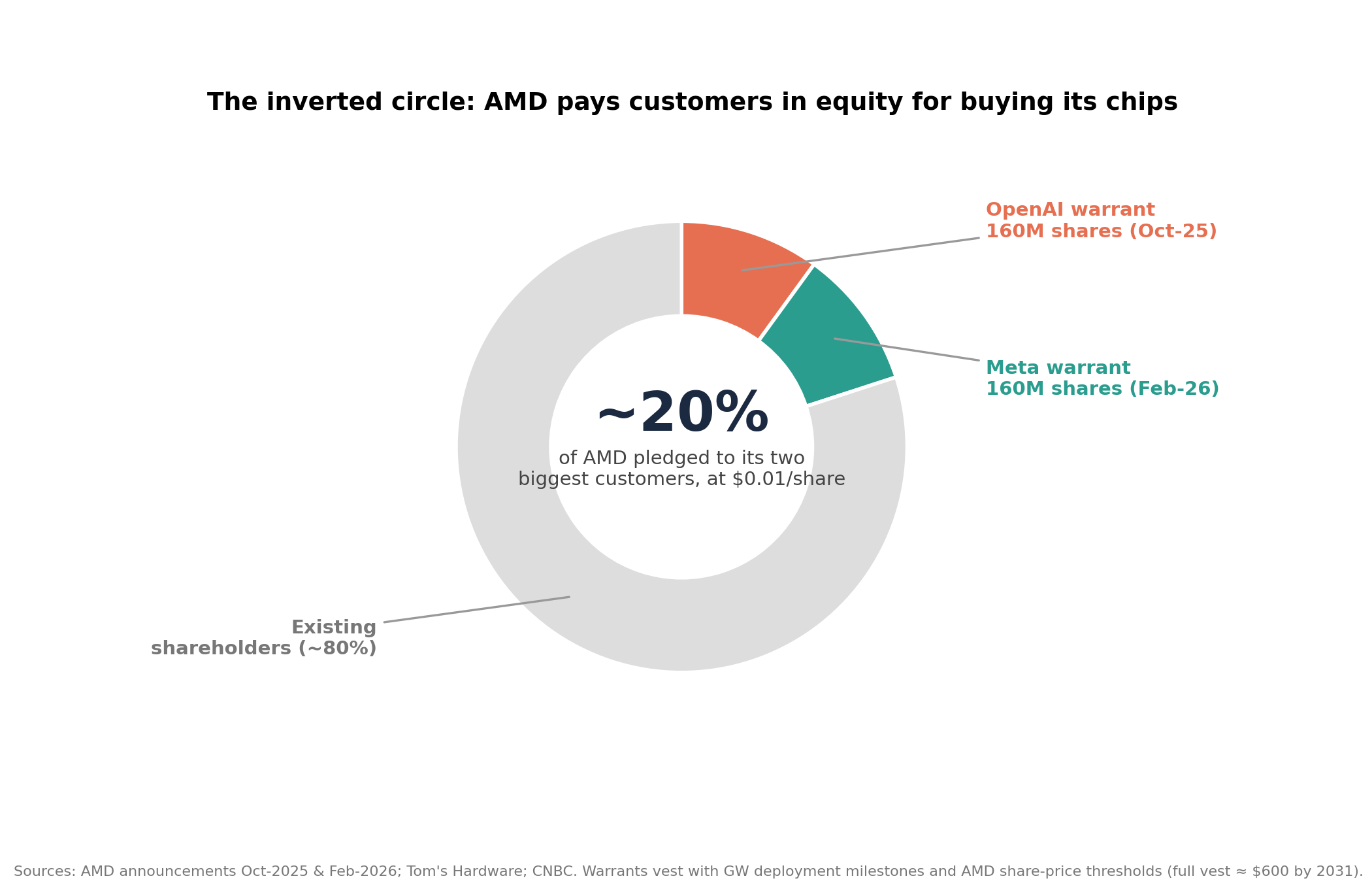
The market got a live demonstration of what those deals are actually made of on July 1. AMD had set its all-time record close the day before. Then Bloomberg reported that Meta — anchor customer, future 10% owner — plans to sell its surplus AI compute. AMD fell 6.9%, about $65 billion of market value, in one session. Because here is the fine print: only the first Meta gigawatt is near-firm; gigawatts two through six are options. The market had been valuing options as backlog, and repriced them in an afternoon.
Loop four: the Musk loop
The freshest circuit was assembled in the six weeks before SpaceX’s IPO.
Background: xAI — builder of the giant Colossus data centers in Memphis, stuffed with Nvidia chips partly financed through a special-purpose vehicle that Nvidia itself invested in — merged into SpaceX. In May, Anthropic signed on at $1.25 billion a month through May 2029, ultimately covering Colossus 1 and 2 (~325,000 Nvidia GPUs). On June 5, one week before listing, Google signed for $920 million a month for ~110,000 GPUs, a deal disclosed in the amended S-1. Combined: roughly $26 billion a year of freshly signed compute revenue, sitting in the prospectus as SpaceX priced its June 12 IPO at about $1.75 trillion.
Every layer disclosed; the sequencing is the story. And the durability is the question: Google publicly framed its lease as short-term bridge capacity for surging Gemini demand, and the contract gives either side a 90-day exit beginning January 2027 — and Anthropic’s lease carries a mutual 90-day exit of its own after an initial period. Essentially all of that $26 billion a year can be switched off with notice letters. SpaceX’s first quarters as a public company will tell us whether pre-IPO revenue and post-IPO revenue are the same substance.
Loop five, briefly: the neoclouds
The small print of the system is a ring of Nvidia-seeded rental companies — CoreWeave, Nebius, Nscale, Lambda. Nvidia owns ~7% of CoreWeave and has committed $6.3 billion to buy capacity back from it — that is, to rent its own chips. CoreWeave's customers are Microsoft, Meta, and OpenAI; OpenAI both signed $22.4 billion of contracts with CoreWeave and received $350 million of its equity. Microsoft alone has committed something like $37 billion-plus across Nebius, IREN, CoreWeave, and Lambda — capacity purchases that, conveniently, are not capex. The debt financing the whole ring is collateralized substantially by the GPUs themselves. When Meta's surplus-compute story broke, Nebius fell harder than AMD. The periphery feels every tremor at the center.
So is it fraud? (No. And the distinction is the whole article.)
Time to be boring, because boring is where the truth lives.
There is a legal and economic bright line between what you’ve just read and the thing it superficially resembles. Round-tripping — the dot-com sin — meant sham transactions with no economic substance, booked purely to inflate reported results. Global Crossing and Qwest swapping identical fiber capacity with each other and calling it revenue; that ended in SEC enforcement. Nothing public in the AI web matches that pattern. In these deals, cash moves one way and chips or compute move the other. Product ships. Models train. Bloomberg’s own guide to the circular deals makes the distinction explicit, and so should we.
The correct historical rhyme is vendor financing — Lucent and Nortel in the late 1990s, lending billions to their own telecom customers to buy their own gear. The revenue was real. The equipment was real. The problem arrived later, when the customers turned out to be running on the vendors’ money rather than their own, and the receivables came home as losses. Vendor financing built the railroads and the telephone network too; it is a tool, not a crime. What it reliably does is defer the market test. Demand that is subsidized by the seller looks identical to organic demand right up until the subsidy stops.
Jim Chanos put the skeptic’s version in one line: it’s a bit odd to proclaim infinite demand for your product while you’re subsidizing your buyers. Michael Burry’s preferred analogy is Cisco in March 2000 — a company that committed no fraud, reported real revenue from a real buildout, and still fell nearly 90% when the spending wave it sat on top of normalized.
So no: the claim here is not that anyone is cooking the books. The claim is narrower and, I think, scarier for being legal — the numbers are real, disclosed, and not independent of each other. Ten tickers, one dollar, counted several times.
Where the flattering actually happens
If the revenue is real, where exactly could the picture be prettier than the reality? Four mechanisms, in descending order of how much money is attached.
Depreciation — the earnings lever. This is the closest thing to a quantified “inflated accounts” claim on the table, and it comes with a famous name attached. In November, Michael Burry accused the hyperscalers of stretching the accounting life of Nvidia-based hardware to five or six years against a two-to-three-year product cycle — a practice he called “one of the more common frauds of the modern era” — and estimated roughly $176 billion of understated depreciation across the industry from 2026 through 2028. By his math, Oracle’s reported profits could be overstated by ~27% and Meta’s by ~21% by 2028. He is talking his book: disclosed put options against Nvidia and Palantir. And the rebuttals are genuinely substantive — GAAP grants wide latitude on useful-life estimates, depreciation is non-cash so free cash flow is untouched, and Nvidia argues customers observe four-to-six-year economic lives as chips cascade from frontier training down to inference work. But note the tell worth watching: the industry spent 2020–2024 extending server lives in lockstep, and in 2025 the consensus cracked — Amazon shortened the life of a subset of its servers while Meta extended further. Two companies looking at the same silicon and reaching opposite conclusions is an estimate, not a fact. Estimates are where earnings are made.
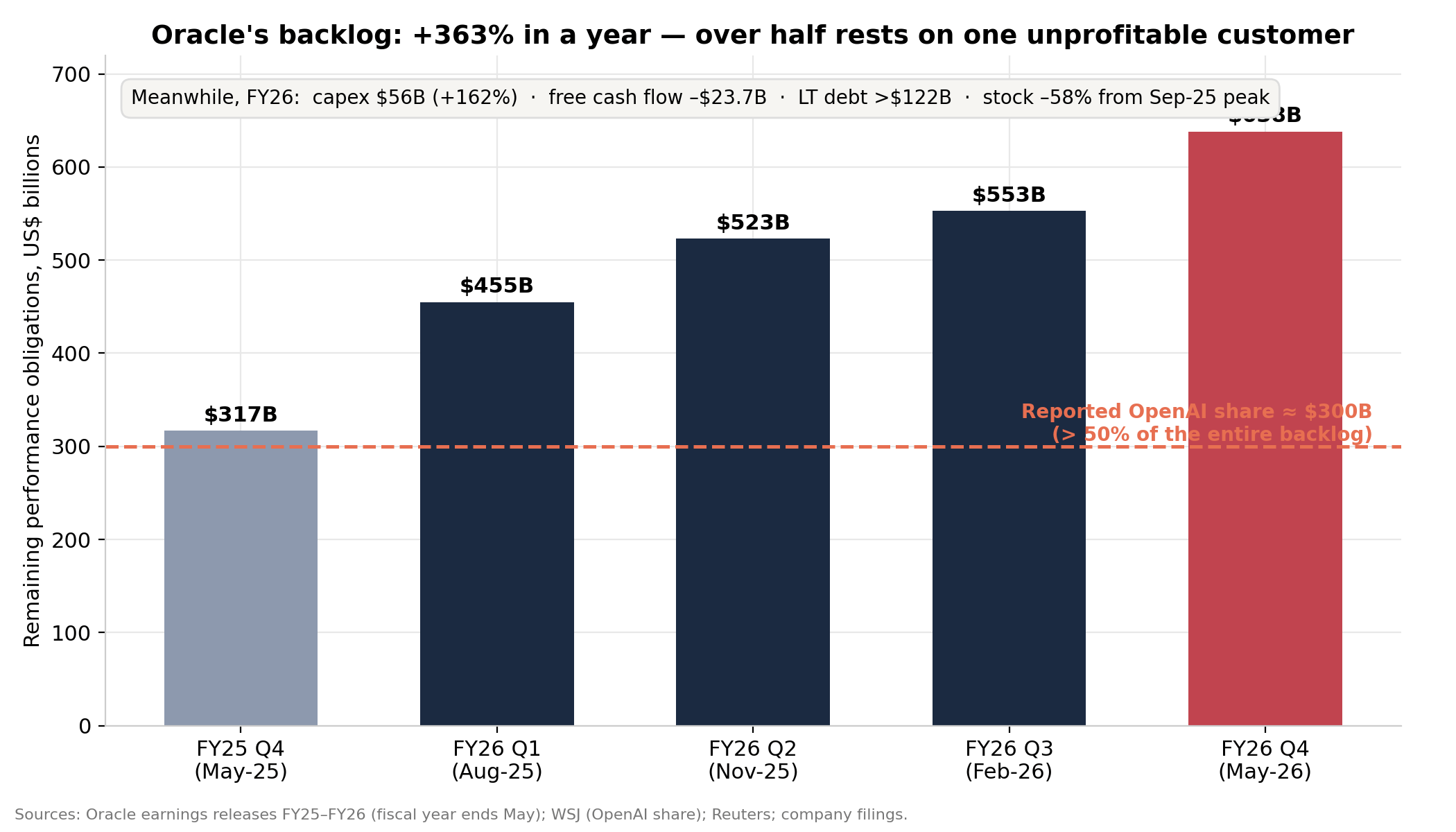
Backlog quality — RPO is not revenue. Oracle is the natural experiment. Its contracted backlog quintupled in a year to $638 billion — more than eight years of current revenue — and the stock initially repriced as if the backlog were cash. Then the composition sank in: over half of it, roughly $300 billion, rests on a single customer that lost $20.9 billion from operations in 2025 — with a first-quarter 2026 run-rate near $28 billion — and Oracle’s own filings warn that under half of the backlog converts to revenue within three years even in the best case. Building the capacity to serve that promise took Oracle’s capex up 162% to $56 billion, swung free cash flow to negative $23.7 billion, pushed long-term debt past $122 billion, and — after a peak near $346 in September — left the stock down about 58%. Same company, same contracts, same accounting throughout. The only thing that changed was how the market chose to count a promise.
Announced versus firm — the conditionality gap. The industry's headline numbers are ceilings; the floors are much lower, and the conditions are doing heavy lifting. A sample:
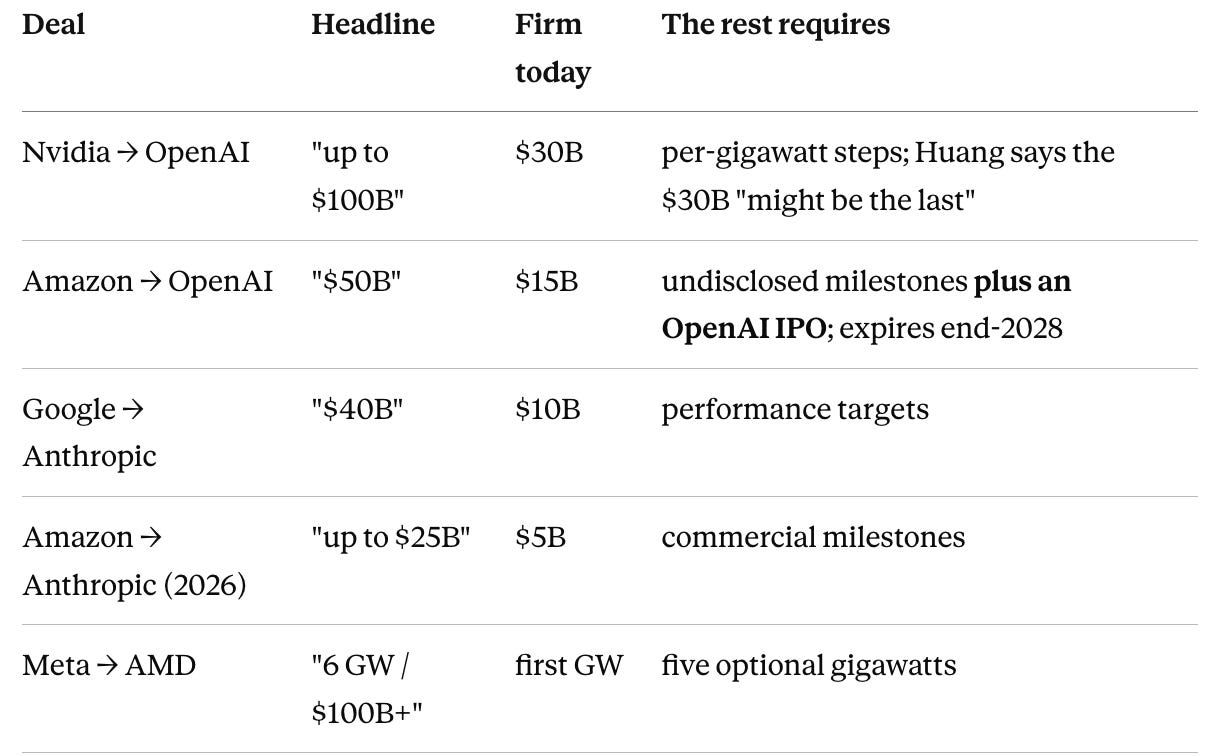
Two of those conditions have already wobbled: OpenAI reportedly delayed its IPO in late June — which gates Amazon's $35 billion — and Meta's surplus-compute plans cast a shadow over its optional AMD gigawatts. A discipline I'd recommend to every reader: keep three columns in your head — announced, contractually firm, actually disbursed. The first is roughly double the third.
Structures and footnotes — where the leverage went. Meta's Q1 filing discloses $237.7 billion of contractual commitments, mostly cloud capacity, living in the footnotes rather than on the face of the balance sheet; its biggest campus is financed through an SPV so the debt largely isn't Meta's; Oracle credits "customer-supplied equipment" for limiting its out-of-pocket risk. None of this is hidden — that's the point, it's disclosed — but the leverage of the system has migrated to the places annual-report readers skim. The early-warning gauges are therefore not income statements but credit markets: spreads and CDS on the infrastructure names, and the appetite of private-credit lenders. One of those lenders, Blue Owl, has already walked away from a $10 billion Oracle data-center financing, citing the spending pace. The marginal dollar is getting choosier.
Three stress tests the market already ran
We don’t have to speculate about how this system behaves under load. It has been kicked three times in five months.
February 2. The Wall Street Journal reported Nvidia’s $100 billion OpenAI plan had stalled amid concerns about OpenAI’s spending discipline. Within 48 hours: Altman rebutted on X, Jensen Huang reframed Nvidia’s approach as investing one step at a time, and Oracle — a bystander, nominally — felt compelled to issue a statement that the news had zero impact on its OpenAI relationship. When a company answers a question nobody asked it, you have learned something about the question. Three mega-caps repriced on one story about one link in the chain.
Late June. Reports that OpenAI would push back its listing gave Oracle its worst week in years. Trace the wiring: the IPO gates Amazon’s $35 billion tranche, and OpenAI’s ability to pay a $300 billion cloud bill depends on continuous access to other people’s capital. A private company’s calendar moved a roughly $400 billion company.
July 1. Meta hints it may resell spare compute; AMD loses $65 billion of market value in a day off a record high, and Nebius fares worse. Optionality that had been priced as backlog got repriced as optionality.
Each episode resolved without contagion. Each also lit up, briefly and helpfully, exactly which wires connect to which.
The bull case, stated fairly
An honest version of this piece has to explain the strongest counter-evidence, which is not weak. Google Cloud grew 63% last quarter on a $460 billion-plus backlog built from thousands of enterprises — management expects more than half of it to convert to revenue within 24 months — and the market rewarded Alphabet’s capex raise even as it punished Meta’s, which tells you investors can distinguish backlog quality when they try. Azure grew 40% with more demand than Microsoft has electricity. Anthropic’s run-rate hit $47 billion by mid-May (from $9 billion at year-end) on actual paying customers, with profitability projected for Q2 2026; ChatGPT passed 900 million weekly users and OpenAI’s revenue tripled year-over-year — the demand curve itself is not in dispute. Asset managers like Janus Henderson describe the deal web not as a house of cards but as a rational way to line up suppliers, builders, and buyers in a genuinely supply-constrained market — and note that in the core Nvidia relationship, unlike the fiber swaps of 2000, product and cash flow in one direction only.
All of that can be true simultaneously with everything above it. The demand is real and partially manufactured; the honest debate is entirely about the ratio. Which is why the only number that settles the argument is the one the loop cannot generate: revenue arriving from outside the circle.
What I’m watching
A short dashboard for the next twelve months. Nvidia's receivables and customer-concentration disclosures, because vendor-financing strain surfaces there first. Oracle's short-term backlog conversion and its credit spreads, because Oracle is the canary — negative free cash flow, $122 billion of debt, and half its future riding on one customer's funding calendar. Depreciation footnotes across the big four, because the first company to quietly shorten a useful life is conceding Burry's point in the only language that counts. The Amazon–OpenAI second tranche and the IPO that unlocks it — a confidential S-1 is now on file, with reporting pointing to a listing as early as September. Anthropic's listing, its own confidential S-1 filed June 1, which would put audited financials under the sector's second pillar. Meta's compute-resale experiment, which converts the biggest pure buyer in the system into a competitor of its own suppliers. And SpaceX's first earnings reports, where we learn whether $26 billion a year signed on the courthouse steps survives contact with the 90-day exit clauses.
The bottom line
The dot-com era’s scandal was fabricated revenue. This era’s exposure is something subtler: authentic revenue with a synthetic origin story. The chips are real, the data centers are real, the invoices clear. But a meaningful share of the demand is being financed by the suppliers, priced by the investors, and counted by the market — several times over, once per ticker.
Maybe the end demand arrives and the loop dissolves into ordinary commerce, the way telecom’s vendor-financed buildout eventually carried the actual internet. Maybe it doesn’t, and we rediscover what Lucent’s shareholders learned: that a customer running on your money is a receivable, not a market.
Either way, the honest headline isn’t “they’re faking the numbers.” It’s worse, in a way, because there’s no villain to catch: the numbers are real. They’re just not independent. And $700-billion-plus a year is a lot to spend on the assumption that nobody ever asks how many times the same dollar has been counted.
Not investment advice. Figures as of early July 2026; announced values unless noted, with conditional tranches flagged. Interpretive claims about depreciation and earnings are Michael Burry’s publicly disclosed allegations and are disputed by the companies and by Nvidia; no regulator has made findings of improper accounting against any company named here.