

TBFG Weekly Brief: July 12.
Market data as of Friday July 10 close. Analysis, not financial advice — do your own homework.
TLDR: The Narrative
There’s a smoke detector chirping in the hallway this week, and the market decided it was just a low battery.
The United States bombed Iran. Commercial ships were hit in the Strait of Hormuz, the passage that carries roughly a fifth of the world’s seaborne oil, and traffic through it fell below half its normal level. Washington yanked the waiver that let Iranian barrels reach the market. Oil jumped. By any ordinary reading of the tape, that is a week stocks lose.
Stocks did not lose. The S&P 500 closed Friday at 7,575.39, up about 1.3% on the week and roughly half a percent from a record high. A South Korean memory-chip maker walked onto the Nasdaq at a trillion-dollar valuation and its shares popped double digits. Meta ran about 15%. The market looked straight at a shooting war in the Gulf and kept eating dinner.
Two things held the floor up, and they are the same two things that have held it up all year. One is the AI build-out, which does not care what oil does and shows no sign of spending less — SK Hynix’s debut was a receipt for that. The other is de-escalation: by Friday the President had agreed to keep talking to Tehran, Qatar was mediating, and oil gave back part of its spike. A war that gets talked down is a war the market can price.
Here’s the part worth your attention. While equities shrugged, the bond market did not. The 10-year yield pushed to 4.56%, and futures moved to price a Fed hike in September — not a cut — because a Gulf oil shock is, before anything else, an inflation story. The smoke detector isn’t the war. It’s the yield.
Earnings Spotlight
Q2 season opened on a split screen. Delta beat and, more telling, held its full-year guidance while paying up for jet fuel — the airline is passing higher costs through in higher fares and the customer is still flying. That’s pricing power in a business that rarely has it, and it says the consumer at the top of the income stack hasn’t blinked.
PepsiCo told the other half of the story: a mixed quarter, strong abroad and soft in North America. When a staple this defensive is leaning on its overseas business to carry the number, the domestic middle is tightening its belt. Two prints, two different consumers.
The loudest earnings-adjacent event wasn’t an earnings report at all. SK Hynix’s US listing — a $26.5 billion raise, ADRs up around 13% on day one — is the market voting, again, that the memory shortage feeding AI is real and durable. Believe the demand. Just remember what memory chips have always been underneath the story: cyclical.
United States
The macro calendar was quiet on prints and loud on positioning. The June FOMC minutes landed, the Fed’s tone stayed watchful, and the market did the rest of the work itself. By Friday, CME futures had roughly a 61% probability of a rate hike in September priced in. Read that twice — the debate has quietly shifted from how many cuts to whether the next move is up.
That’s the oil shock bleeding into rates. The real week is next week: new Fed Chair Kevin Warsh testifies to Congress on July 14, and June CPI lands the same morning. If the inflation number runs hot into a Gulf supply scare, the September conversation gets uglier fast. The 10-year at 4.56% is the market front-running that risk while the stock market looks the other way.
Europe
Europe spent the week living inside a deal it already signed. The EU–US framework capping tariffs at 15% has been live since July 1, and it removes a variable that hung over European exporters for most of the year. Lagarde is still warning that trade uncertainty can return, which is the correct thing for a central banker to say and also not a market-moving one this week.
The more consequential European story runs underground, through the gas network — which brings us to the North Sea.
World
The center of gravity this week was the Gulf, and its most important second-order effect for our readers is energy.
Norway is quietly doing the job it has done since 2022: being Europe’s most reliable gas supplier at exactly the moment the Middle East looks least reliable. Equinor is expanding output at Troll and has been tying back smaller fields like Eirin, which came online this spring, to keep gas flowing into the European network. None of it is dramatic. That is the point — while the Strait of Hormuz runs at half-capacity, the barrels and molecules Europe can actually count on come from a cold, boring, politically stable shelf in the north. Equinor doubled its buyback earlier this year on a bet that oil and gas demand stays firmer for longer, and this week did nothing to argue against it.
The offshore complex — the rigs, the supply vessels, the service names — is the leveraged version of that same trade. When Hormuz is the question, the North Sea is one of the answers.
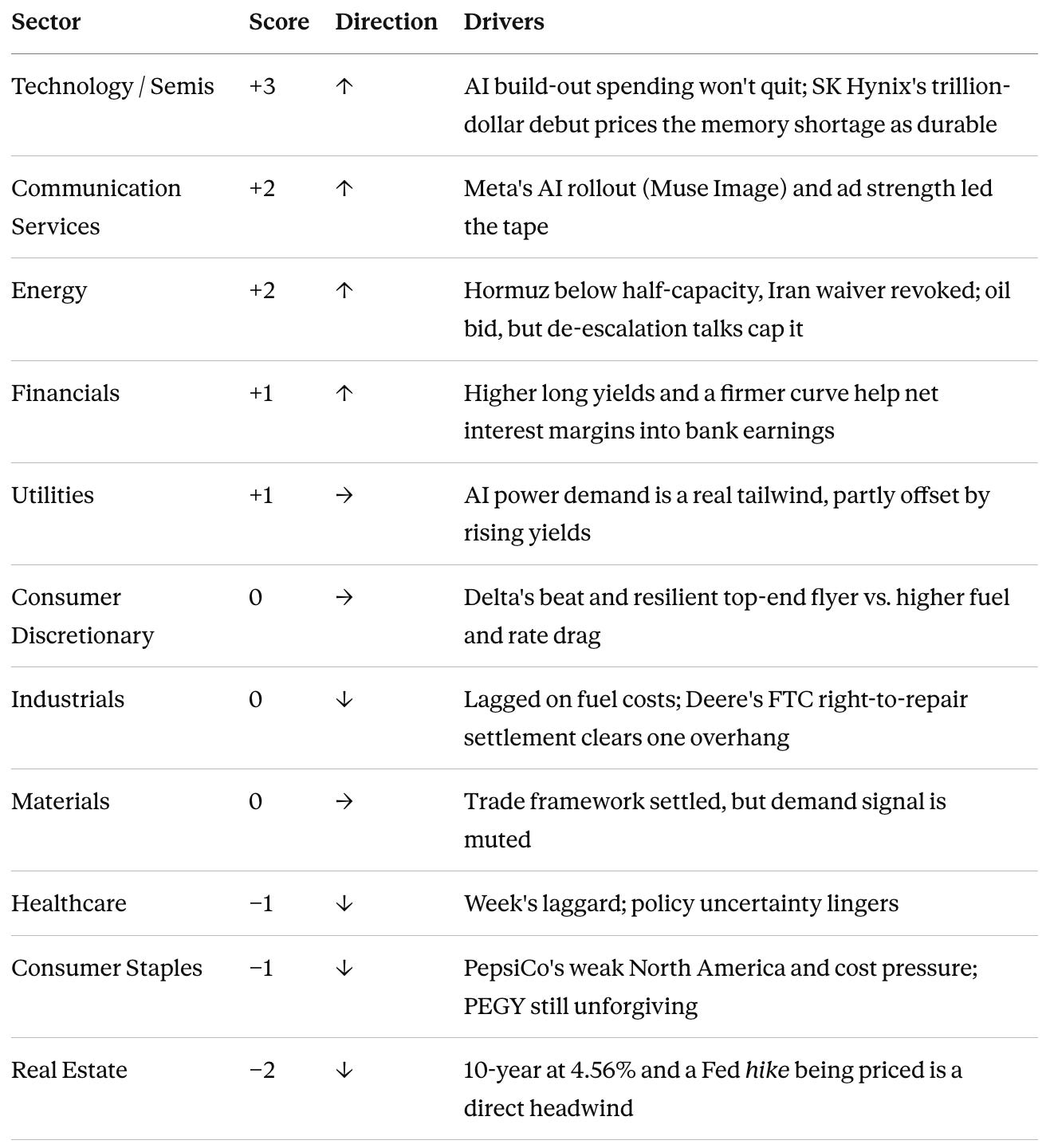
Sector Scorecard
Scoring the structure, not the week’s price action. −3 (strong structural headwind) to +3 (strong structural tailwind).
Bottom line
The week’s lesson isn’t that geopolitics doesn’t matter. It’s that the market has decided which risks it’s willing to price and which it isn’t. It priced a war it thinks gets talked down. It priced an AI build-out it thinks doesn’t stop. What it hasn’t fully priced is the thing sitting between those two: an oil shock that turns into an inflation problem, and a Fed whose next move might be up rather than down. Equities are watching the war. The bond market is watching the thermostat.
So the smoke detector keeps chirping in the hallway. Maybe it really is just the battery, and July 14’s CPI print comes in cool and the September hike talk fades. Maybe it isn’t. The calm thing to do is neither panic nor ignore it — it’s to notice that the alarm is wired to the same circuit as your valuations, and to price your positions as if the number could come in hot. Boring compounds precisely because it doesn’t need the alarm to stay quiet forever.
This week’s Portfolio Actions cover three names: Delta, Equinor and SK Hynix — one Add, one Watch, one Avoid. Members see which is which, and why.
Company-Focused Portfolio Actions
TBFG thought on what stock to Add, Watch or Avoid based on this Weekly Brief. The Portfolio action section is available for TBFG Premium member.
