

TBFG Weekly Brief: July 19.
Monday 13 – Saturday 18 July 2026. Market data as of Friday's close, 17 July 2026.
TLDR: The Narrative
For two years the AI trade only had to show up to get paid. This week it showed up — and got sold anyway.
Taiwan Semiconductor put up the best quarter in its history. Profit up 77%. Gross margin near 68%. It raised its capital-spending plan to somewhere north of sixty billion dollars and told everyone the next three years would be bigger still. ASML, the company that sells TSMC its machines, raised full-year guidance for the second time this year. If you wanted proof that the AI build-out is real and still accelerating, you got it in writing on Wednesday and Thursday.
And the chips fell into a correction.
The trigger was a name most readers had never heard of on Monday: Kimi K3, a Chinese model from a startup called Moonshot AI, released open-weight and priced to undercut. It was DeepSeek all over again — the same jolt that hit these stocks in early 2025, the same question underneath it. If a competent model can be built and run for a fraction of what the market assumed, then some of the premium baked into the American AI stack is paying for a moat that may be narrower than the price says. The Philadelphia chip index has now given back 13% in a month. It is still up 63% on the year, which tells you how much air was in it to begin with.
Here is the part worth sitting with. The businesses delivered and the prices dropped. Netflix beat on earnings, guided growth a touch lower, and fell almost 9% to a one-year low. That is not what a crash looks like. That is what a crowded trade looks like when the crowd decides, all at once, to stand somewhere else.
Picture everyone on a ferry piled onto the same rail for the view. When they rush to the other side, the boat doesn’t capsize — but it still rides lower in the water while the weight moves. That was the week. For every dollar that left Nvidia, some went into a bank that was actually minting money — and the rest just got off the boat. The rotation was real: banks up, chips down. It cushioned the fall without erasing it. The S&P 500 still finished the week down 1.55%, the Nasdaq down 2.9%. Not a rout. A market taking a step back and changing who leads on the way.
Under all of it, a second, quieter shift: the cheap-oil dividend that had been flattering every inflation print reversed hard. Brent jumped from about $79 to $88 as the Iran ceasefire frayed and tankers came under fire near Hormuz; US crude closed near $82. June’s lovely −0.4% CPI was built on gasoline falling almost 10% in a single month. That tailwind is now blowing the other way, and with more force than the chip headlines suggest.
The story of the week in one line: the tape stopped paying for good news in the one place it always had, the leadership changed rails even as the whole boat rode lower, and the calm-inflation trade sprang an oil leak.
Earnings Spotlight
The AI supply chain aced the test and the market marked it down. TSMC’s quarter was the cleanest read on demand you will get: revenue of $40.2 billion, up 34% from a year ago; net profit up 77%; high-performance computing now two-thirds of wafer revenue. Management didn’t hedge — it lifted 2026 growth guidance to above 40% and raised capex to $60–64 billion, saying the binding constraint isn’t demand but advanced-packaging capacity, which is sold out more than a year forward. ASML echoed it with a second guidance raise. When the picks-and-shovels names raise numbers, the build-out is real. The stocks fell anyway, because the debate has moved from is the demand there to what is that demand worth per share.
Netflix is the tell. Revenue landed at $12.56 billion, a hair light; earnings of $0.80 nudged past estimates. The problem was the shape of the growth: 11% and cooling, with guidance that didn’t excite. The stock dropped almost 9% to a 52-week low. A good business, a fine quarter, and a price that had already spent the good news.
The banks were the week’s real winners. JPMorgan earned $6.14 a share against a $5.85 estimate on $58 billion of revenue, with Jamie Dimon crediting AI-related capital investment and fiscal spending as tailwinds. Bank of America grew revenue 15% and investment-banking fees 50%. Wells Fargo beat cleanly. Dealmaking and trading came back to life, and the market — for once — paid up for the beat instead of selling it. Even Travelers, the least glamorous name imaginable, jumped 9% on Friday. Boring got rewarded. That is the whole rotation in miniature.
United States
The macro news was good, and it is already dated. June CPI fell 0.4% on the month and sits at 3.5% over the year, with core steady at 2.6%. Read the internals and the calm is borrowed: energy fell 5.7% in the month and gasoline dropped almost 10%, which did most of the work. Retail sales rose 0.2% — spending is holding, not accelerating, with the tax-refund bump behind us. Consumers are steady and a little tired.
The Fed stays on its hands. With inflation cooling on paper, traders still don’t have the clean setup they want, and Powell has been plain that tariffs are the reason cuts keep getting pushed out — the levies feed into goods prices and muddy the read. There is no July cut priced with conviction. The June inflation print was friendly, but it was written in a month when oil was cheap. July’s won’t have that luxury. The number that let everyone relax is the one least likely to repeat.
Europe
Europe spent the spring building a wall and then agreeing on its height. The EU–US tariff framework is now live at 15%, implemented on both sides — not free trade, but a known cost, which markets can price far more easily than a threat. The certainty is the win.
The European angle this week ran straight through the chip story. ASML, the closest thing the continent has to an AI keystone, raised guidance again — a reminder that the most important company in the AI hardware chain sits in the Netherlands, not California. It sold off with the group regardless. When New York decides semiconductors are expensive, Eindhoven doesn’t get a vote.
World
The week’s second wall went up in the water. The June ceasefire between the US and Iran frayed: reports of tanker attacks near the Strait of Hormuz, fresh military exchanges, and Iran signalling transit restrictions “until further notice.” The Strait carries roughly a fifth of the world’s seaborne oil, so the market did the arithmetic and moved crude up hard — Brent from about $79 to $88, US crude (WTI) to about $82, a double-digit weekly gain.
That puts Norway and the offshore complex back on the right side of the ledger. Equinor and the North Sea names live and die by the crude curve, and a geopolitical risk premium lifts realised prices without any of them lifting a finger. The caution worth stating plainly: this is a fear premium, not a demand story. Fear premiums are real while they last and vanish without warning — the same barrel that jumped on a headline in July gave it all back in June when the last ceasefire held. Higher oil helps the producers and quietly taxes everyone else through the pump and the next inflation print.
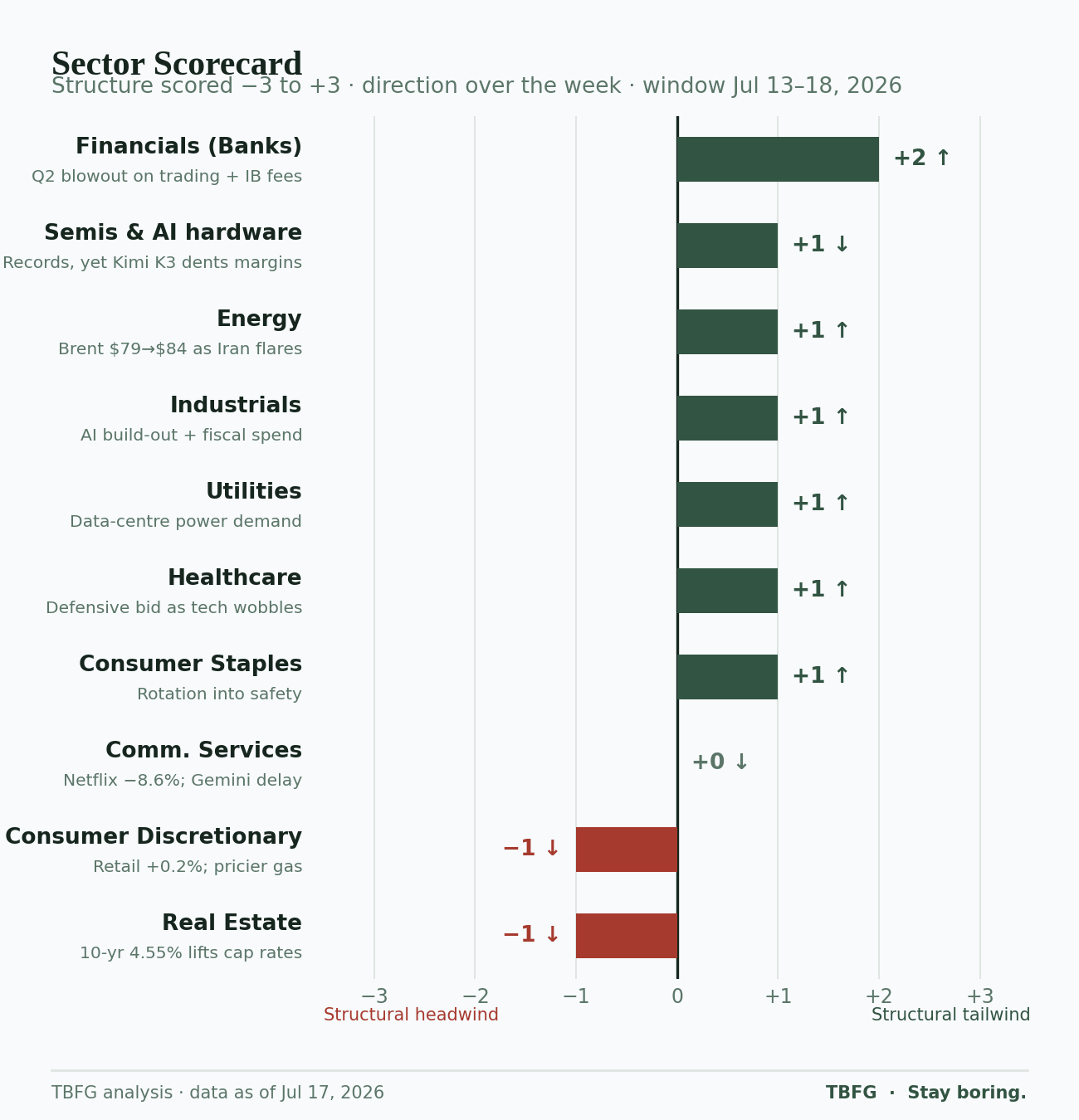
Sector Scorecard
Scored on structure — the wind at each sector's back or in its face — not on the week's price action. Direction is the trend over the window.
Bottom line
What the week told us is simple and a little uncomfortable for anyone long the obvious. The AI trade is no longer a one-way bet where showing up is enough. The demand is real — TSMC and ASML settled that argument in writing — but the price is now doing its own thinking, and a single Chinese model was enough to knock the chip index into a correction while the fundamentals were improving. That gap between the business and the stock is the whole game. It is also exactly where a price-first investor earns their keep.
The healthy signal underneath the scary headline: this wasn’t blind selling. It was a rotation. Banks printing record fees, defensives catching a bid, money moving out of the crowded megacap chips and into parts of the market that had been left for dead. The index still fell — the rotation cushioned the blow, it didn’t cancel it — but a market that can sell its leaders, buy something else, and step back only 1.5% is a market with more than one idea in it. That is sturdier than the version where seven stocks carry everyone and there’s nowhere to hide when they wobble.
The risk that matters into next week isn’t the Kimi headline — it’s the oil leak. June’s benign inflation was built on cheap gasoline, and gasoline just reversed on a geopolitical premium that could evaporate or could get much worse. Watch the crude curve, not the chip chatter. The barrel will tell you more about the next CPI than any model launch.
So: don’t chase the crowd’s old corner, and don’t panic when it empties. When the whole boat leans to one rail, the opportunity is usually standing quietly on the other one. This week that other rail had a bank on it, an oil producer, and one wonderful business that finally got marked down to a price worth a second look.
Company-Focused Portfolio Actions
This week’s Portfolio Actions cover three names: Taiwan Semiconductor, Netflix and Nvidia — one Add, one Watch, one Avoid. Premium Members see which is which, and why.
