

TBFG Weekly Brief: July 26
Monday 20 – Saturday 25 July 2026. Market data as of Friday’s close, 24 July 2026
TLDR: The Narrative
For two years the deal was simple. Big Tech could spend whatever it wanted on AI, and the market would clap. This week two of them tried it again, and the room went quiet.
Alphabet reported a strong quarter and then told everyone it now plans to spend somewhere between $195 and $205 billion this year, and to raise up to $85 billion in fresh equity to help pay for it. The business is a cash machine; this year it will spend more than the cash machine makes, and slip into negative free cash flow to do it. The stock fell almost 7%. Tesla did its own version the same night: capital spending headed above $25 billion, up from around eight, nearly six billion burned on AI in a single quarter, free cash flow negative for the first time in two years. The stock dropped double digits. By Thursday’s close the seven biggest names in the market had shed roughly $800 billion between them — the worst single day since the tariff panic of April 2025.
Anyone who has renovated a kitchen knows the feeling. You approve the budget. Then the contractor comes back: it’ll cost a little more, but it’ll be spectacular. Then he comes back again. At some point you stop nodding and ask to see the cabinets. This week the market asked Alphabet and Tesla to see the cabinets, and the honest answer was: still being built, trust us.
Here is what makes it more than a tech tantrum. The spending itself is real, and it is real demand for chips and power and steel — Alphabet writing a $200 billion cheque is a very good week for whoever sells it the hardware. The market didn’t doubt the demand. It doubted the price it had been paying for the promise of a payoff, and it stopped extending unlimited credit on faith. That is a different thing, and a healthier one.
While the market was auditing Big Tech’s spending, a second bill arrived from a place no spreadsheet models well. The oil leak this letter flagged a week ago didn’t just widen; it burst. Fresh US strikes on Iran and a naval blockade of its ports put Brent crude over $100 a barrel for the first time in years before it eased back Friday on talk of negotiations. Oil above $100 is not a chart squiggle. It is a tax on every business that burns fuel and every household that drives, and it lands straight in the next inflation print.
You can see where that goes. The bond market did the arithmetic and repriced hard: the 10-year yield jumped toward 4.7%, and — read this twice — futures now put better than one-in-three odds on the Fed raising rates next week rather than cutting. A month ago the debate was how many cuts. Now it’s whether the next move is up.
One floor is still holding. Jobless claims came in at 187,000, the lowest since 1969. The labour market that has refused to crack for two years still won’t. That is the plank keeping this from being something worse.
The story of the week in one line: the market stopped financing the AI build-out on promises, a real war premium put oil over $100 and flipped the rate debate from cuts to a hike, and the only thing still holding the floor up is a jobs number from 1969.
Earnings Spotlight
Alphabet and Tesla beat, and the market sold them anyway — on the spending, not the sales. This is the same lesson as last week, harder. A quarter can be good and the stock can still fall if the good news was already in the price and the guidance asks for more patience than the buyer has left. Alphabet’s revenue was strong; the story became a capex line of roughly $200 billion and an $80-billion-plus equity raise to fund it. Tesla’s story became negative free cash flow and a spending plan that tripled, all of it aimed at robotaxis, humanoid robots, and a chip fab that won’t earn a dollar for years. Both are betting the company on a future that arrives later than this quarter. The market, for once, asked to be paid for the wait.
The tell is that the sell-off was about funding, not demand. Note what did not happen: nobody cut their AI spending. They raised it. That capex is someone else’s revenue — the chip makers, the equipment sellers, the utilities wiring the data centres. The picks-and-shovels case got stronger this week even as the hyperscaler stocks got cheaper. The thing under pressure is the equity math at companies now spending faster than they earn, not the build-out itself.
Chips caught the downdraft regardless. Intel beat expectations and still fell 6.5%; SanDisk dropped about 11% with the memory names. When a whole complex trades on one mood, a good print is no shelter. That is what a crowded, expensive corner of the market looks like when the crowd decides to trim.
United States
Two forces pulled the macro picture in opposite directions, and by Friday the darker one was winning.
On the good side, the labour market is still remarkable. Initial jobless claims fell to 187,000 — you have to go back to 1969 to find a lower number. Employers are not laying people off. That single fact is why a week with a war premium, a tech rout, and a hawkish rates repricing still ended with the S&P down only about half a percent.
On the other side, the inflation story that looked settled a month ago is unsettling again. Last month’s benign print leaned on cheap gasoline. Gasoline just reversed with oil over $100, and it won’t flatter the next number the way it flattered the last one. The bond market moved first and moved hard: the 10-year yield climbed toward 4.7%, up roughly 15 to 22 basis points on the week, and Fed-funds futures now price about a 37% chance of a rate hike at the July 28–29 meeting. Read the internals and the message is plain — traders are no longer arguing about the size of the next cut; a meaningful slice of them think the next move could go the other way.
Washington added its own weight. A new phase of tariffs took effect at one minute past midnight on Friday: 10% to 12.5% on sixty trading partners, covering better than 99% of what the country imports, justified this time under forced-labour trade law. Energy got carved out, which matters, and USMCA goods stayed largely clear. But the effective tariff rate ticks up another point or two from here, and that too is a slow drip into prices. The Fed keeps saying tariffs are why cuts stay on the shelf. This week gave the point fresh evidence.
Europe
Europe got the lighter end of the tariff stick and should be quietly relieved. The new US schedule puts the EU at the 10% baseline rather than the 12.5% reserved for China, Australia, and Egypt. After a year of threats measured in far larger numbers, a known 10% is something European exporters can price and plan around. Certainty, even expensive certainty, beats a moving target.
The harder read for the continent runs through energy. Europe imports most of what it burns, so a Middle East supply shock lands heavier there than in a US that now exports crude. Oil over $100 pressures European industry and household budgets at the same time the European Central Bank is trying to decide whether its own inflation fight is finished. The tariff news was a relief; the oil news was not, and the second matters more for the months ahead.
World
The week’s defining event happened in the water, not on a trading floor. Fresh US strikes on Iran and a reimposed naval blockade of its ports reopened the question that never fully closes: who controls the Strait of Hormuz, the channel that carries roughly a fifth of the world’s seaborne oil. A Houthi attack in the Red Sea added a second front. Brent crude pushed past $100 a barrel before easing on Friday amid talk of negotiations, closing the week below $99; US crude sat around $90.
For Norway and the offshore complex this is, in the narrow financial sense, a tailwind. Equinor and the North Sea names realise higher prices on every barrel they were already going to pump, and a geopolitical risk premium does the lifting for them. But the caution this letter gave a week ago holds with more force now, because the premium is bigger: this is fear in the price, not demand. Fear premiums are real while they last and vanish the moment a ceasefire holds — the same barrel that broke $100 this week gave back 4% in a single session on nothing more than a rumour of talks. Higher oil is money in Stavanger’s pocket and a tax on almost everyone else’s, collected at the pump and again in the next CPI. It is a reason to respect energy’s structural position, not a reason to chase a spike.
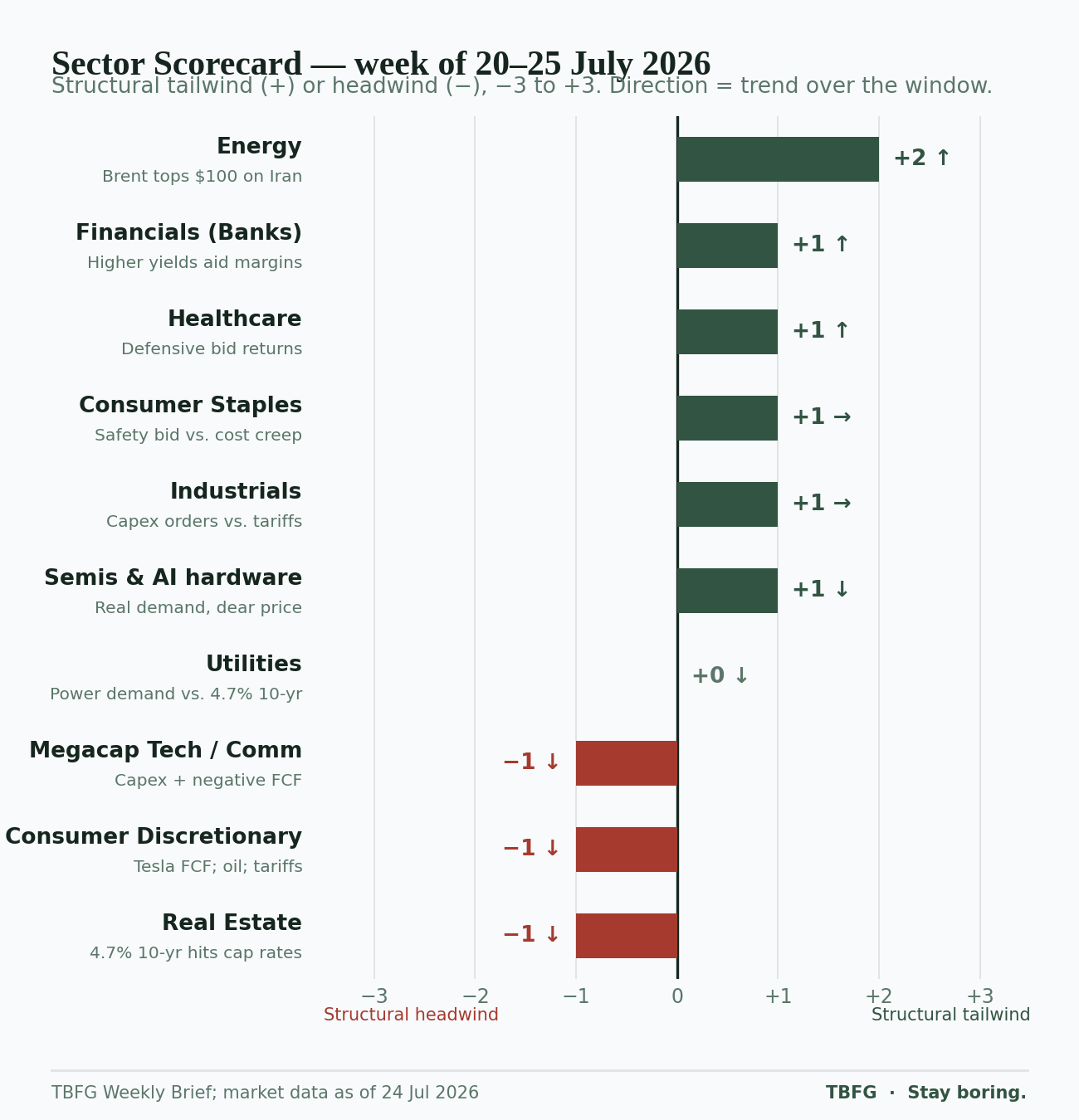
Sector Scorecard
Scored on structure — the wind at each sector's back or in its face — not on the week's price action. Direction is the trend over the window.
Bottom line
The week told us the AI trade has entered its accountability phase, and that is a good thing dressed up as a scary one. For two years the market treated capital spending as a virtue with no ceiling — the more a company promised to spend, the more the stock went up. This week Alphabet and Tesla spent bigger than ever, delivered fine quarters, and got marked down anyway, because the market finally attached a price to the wait between the spending and the payoff. Demand for AI infrastructure isn’t in doubt; the two companies raised their budgets, they didn’t cut them. What changed is that investors stopped paying any price for the promise. That discipline is exactly what a price-first investor has been waiting two years for.
The harder problem isn’t on any income statement. Oil over $100, courtesy of a real conflict rather than a soft demand quarter, has done something the tech story can’t: it has flipped the interest-rate debate. When futures start pricing a rate hike into a market that spent all year expecting cuts, every valuation in every sector gets re-examined, because the discount rate under all of them just moved. Watch the crude curve and the 10-year, in that order. They will tell you more about August than any earnings call.
And keep one eye on the plank still holding the floor: jobs. Claims at a 1969 low are the reason this was a wobble and not a rout. If that number cracks while oil is high and the Fed is boxed in by inflation, the story changes completely. It hasn’t. Until it does, the read is a market re-pricing risk in an orderly way, not one falling apart.
So, back to the renovation. When the contractor keeps asking for more and can’t yet show you the cabinets, the answer isn’t to storm out of the house — it’s to stop signing blank cheques and start paying for finished work. This week the market did exactly that. The opportunities are in the rooms that are already built: an energy trade with a real, if fragile, tailwind; the businesses selling the picks and shovels to everyone spending like mad; and one or two wonderful companies finally getting marked down to a price worth a second look.
Company-Focused Portfolio Actions
This week’s Portfolio Actions cover three names: Alphabet, Equinor and Tesla — one Add, one Watch, one Avoid. Members see which is which, and why.
